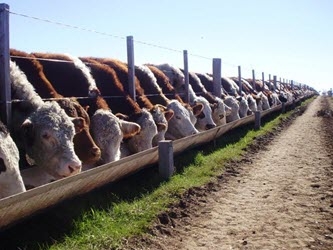
Livestock slaughter weights have been diverging this year with cattle trending down and hogs trending up.
The heavier slaughter weights for hogs likely stem from packers trying to maintain margins by slowing slaughter rates and leaving them to be finished longer. Year-to-date hog slaughter is up 2.8 percent, but pork production is 3.6 percent higher due to the heavier slaughter weights. If those weight levels continue, pork production over the summer, a period when there is a usual seasonal decline, could maintain the year-to-date expansion pace. In the cattle and beef market, the same pattern of final product growth exceeding slaughter rates is playing out but not as dramatically. This is because cattle size is tailing off from the pea...



 The magpie goose (Anseranas semipalmata) is the sole living representative species of the family Anseranatidae. This waterbird is found in northern Australia and southern New Guinea.[2] The species is not truly migratory but it sometimes travels large distances to find food and water, especiall...
 The common ostrich (Struthio camelus), or simply ostrich, is a species of flightless bird native to certain areas of Africa (and historically, Arabia) and is the largest living species of bird. The common ostrich is one of two extant species of ostriches, the only living members of the genus St...
 A pika (/ˈpaɪkə, ˈpiːkə/ PY-kə, PEE-kə[3][4]) is a small, mountain-dwelling mammal native to Asia and North America. With short limbs, a very round body, an even coat of fur, and no external tail, they resemble their close relative the rabbit, but with short, rounded ears.[5] The large-eared pi...

 Lobelia (/loʊˈbiːliə, lə-/[4][5][6]) is a genus of flowering plants in the family Campanulaceae comprising 415 species,[7] with a subcosmopolitan distribution primarily in tropical to warm temperate regions of the world, a few species extending into cooler temperate regions.[8] They are known g...