

Today's USDA export sales report confirmed the continued seasonal trend in U.S. exports of soybeans, soymeal and soyoil. Meanwhile, Brazil's wildca trucker strikes appear to have ended after costing several sectors a great deal of money. Minimal Indian Soymeal Exports in February India exported only 64,514 MT of soymeal in February, according to that country's Solvent Extractors Association. That was a 39.2 percent decline from 104,426 MT in January and almost a 65 percent decrease from 183,550 MT in February 2014. The country has exported only 502,649 MT since 1 October 2014. In the same period a year earlier, the total volume was 1.6853 MMT.India's soymeal exports have fallen so sharply this year because of a smaller-than-normal soybean...


 Fabiana is a genus of flowering plants in the nightshade family, native to dry slopes in western South America.[1] They are evergreen shrubs or subshrubs,[1] with needle-like leaves and profuse tiny tubular flowers in summer. The common name is false heath because the leaves superficially resem...

 The magpie goose (Anseranas semipalmata) is the sole living representative species of the family Anseranatidae. This waterbird is found in northern Australia and southern New Guinea.[2] The species is not truly migratory but it sometimes travels large distances to find food and water, especiall...
 The common ostrich (Struthio camelus), or simply ostrich, is a species of flightless bird native to certain areas of Africa (and historically, Arabia) and is the largest living species of bird. The common ostrich is one of two extant species of ostriches, the only living members of the genus St...
 A pika (/ˈpaɪkə, ˈpiːkə/ PY-kə, PEE-kə[3][4]) is a small, mountain-dwelling mammal native to Asia and North America. With short limbs, a very round body, an even coat of fur, and no external tail, they resemble their close relative the rabbit, but with short, rounded ears.[5] The large-eared pi...

From WPI Consulting
Infrastructure investment due diligence
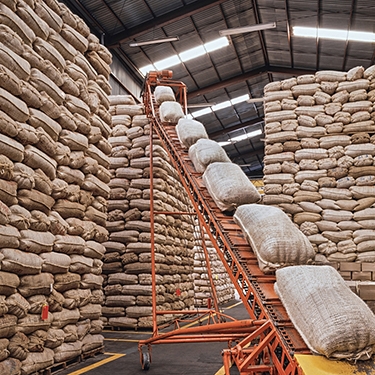
On behalf of a Canadian oilseed processer WPI's team provided market analysis, econometric modeling and financial due diligence in support of a $24 million-dollar investment in a Ukrainian crush plant. Consistent with WPI's findings, local production to supply the plant and the facility's output have expanded exponentially since the investment. WPI has conducted parallel work on behalf of U.S., South American and European clients, both private and public, in the agri-food space.