
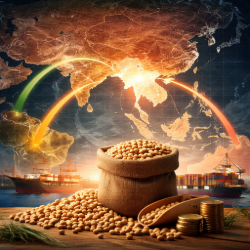
Thailand’s market is now officially reopened to soybean and soymeal imports as the government has resolved a lapse in tariff policy that caused import duties to default to prohibitively high levels earlier this month. On 27 January, the Thai Cabinet approved the continuation of its market-enabling framework and formally restored lapsed WTO tariff-rate quotas through the end of 2028. The decision reopens import channels that were effectively closed when government policy defaulted in early 2026 to a system of high bound tariffs for soybeans and soymeal. For soymeal, Thailand will maintain a WTO tariff-rate quota (TRQ) of 230,559 MT per year from 2026–2028, with an in-quota tariff of 10 percent and an out-of-quota tariff of...



 Fabiana is a genus of flowering plants in the nightshade family, native to dry slopes in western South America.[1] They are evergreen shrubs or subshrubs,[1] with needle-like leaves and profuse tiny tubular flowers in summer. The common name is false heath because the leaves superficially resem...


 The magpie goose (Anseranas semipalmata) is the sole living representative species of the family Anseranatidae. This waterbird is found in northern Australia and southern New Guinea.[2] The species is not truly migratory but it sometimes travels large distances to find food and water, especiall...

From WPI Consulting
Accountability and a comprehensive approach to export programming

WPI’s team helped construct a strategic approach to develop, implement, and track promotional activities in 8 key regions across the globe for an agricultural export association. With continued progress measurement and strategic advisory services from WPI, the association has seen its ROI from investments in promotional programming increase by 44 percent over the past 5 years. Not only does this type of holistic approach to organizational strategy provide measurable results to track and analyze, it fosters top-down and bottom-up organizational accountability.